
Case Studies
RHEO AI Smart Operational Platform helps major industrial manufacturers reduce labor cost while simultaneously improving customer service levels
Abstract
A division of one of the top residential Windows and Doors manufacturing conglomerate was experiencing increasing Labor Costs, while daily throughput remained flat and on-time Customer Service levels were deteriorating. To improve service levels and reduce labor cost, the business needed to quickly understand the primary factors impacting performance of the glass cut process and the specific improvements required to improve performance rapidly.
The overview
Labor costs were increasing, and on-time customer delivery was declining due to the extremely complex interactions of production scheduling, employee turnover, labor rate increases, and equipment unplanned downtime.
Management relied on tribal knowledge and experience to drive process improvements.
Scenario
In a Windows and Doors manufacturing business, the glass cut process is critical, as it provides glass to the insulated glass (IG) assembly lines, which are then mounted on frames to produce windows.
If the glass cut line does not produce the required demand, it negatively impacts the daily capacity of multiple automatic and manual IG assembly lines. Also, as a result of unplanned equipment downtime, and high employee turnover, the business was experiencing insufficient demand fulfillment.
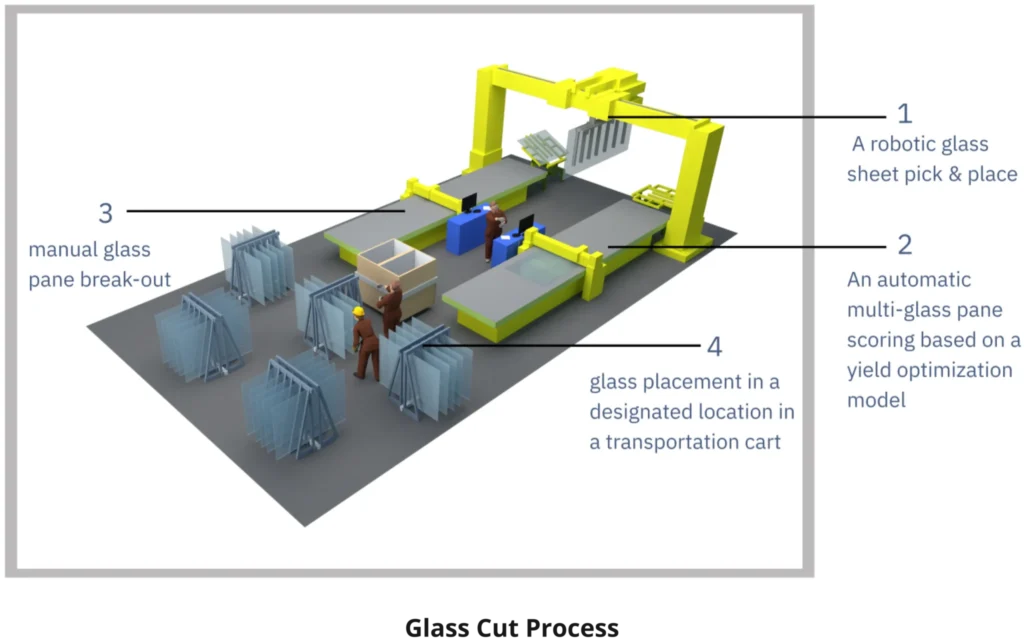
The glass cut process consists of:
A robotic glass sheet pick & place
An automatic multi-glass pane scoring based on a yield optimization model
Manual glass pane break-out
Glass placement in a designated location in a transportation cart
The challenge
Complex multi-variant process difficult to optimize using traditional improvement tools and techniques
Translate qualitative opinions to quantitative facts and data
Data related to equipment downtime was readily available, but the business did not know the downtime root causes. Also, the process optimization complexity is amplified by mixed model batch production scheduling which include variations in glass cut size, thickness, and grade coupled with varying seasonal demand cycles. Optimizing these types of multi-variate processes are extremely complicated to do with traditional cycle time and takt time analysis.
The solution
Translated complex multi-variate process performance data to simple process improvement insights empowered process owners to manage, hypothesize and drive improvements
RHEO AI Smart Operational Platform was deployed to automate data collection, analysis and process visualization using cameras and sensors. The RHEO platform’s integrated intelligence capabilities enabled the process managers, supervisors, leads, and line operators to quantify inefficiencies, in addition to automatically providing real-time identification and prioritization of root causes impacting process performance. This, in-turn, facilitated quick decisions on the actions required to improve performance.
The results
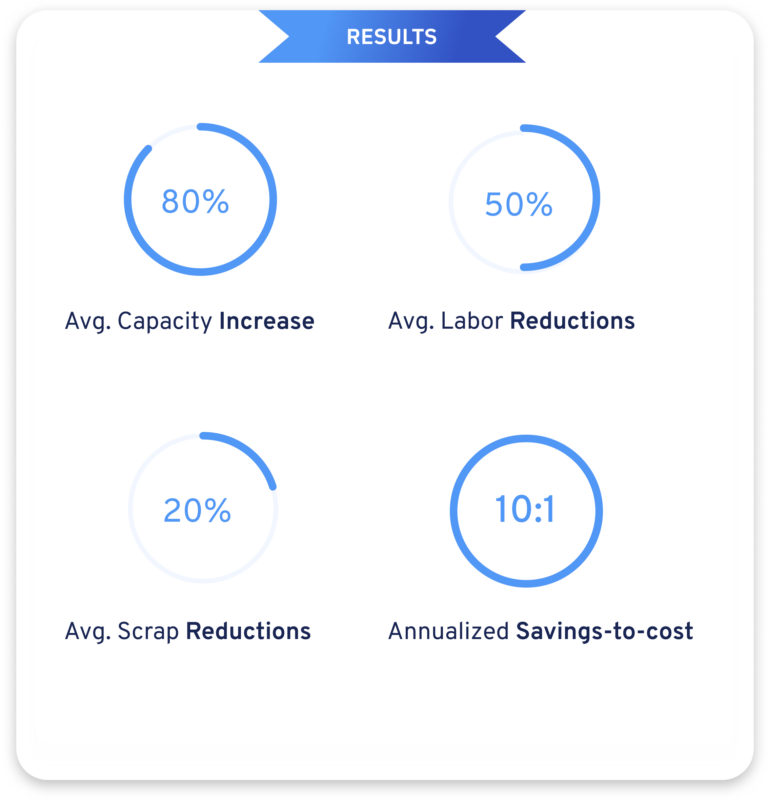
The RHEO system identified EBITDA labor savings (including Overtime) of over Six Figures in the first two weeks of introducing the RHEO system. The manufacturer is currently deploying the RHEO system for the glass-cutting process across several of their plants.
RHEO AI Smart Operational Platform helps major industrial manufacturers reduce labor cost while simultaneously improving customer service levels
Abstract
A division of one of the top residential Windows and Doors manufacturing conglomerate was experiencing increasing Labor Costs, while daily throughput remained flat and on-time Customer Service levels were deteriorating. To improve service levels and reduce labor cost, the business needed to quickly understand the primary factors impacting performance of the glass cut process and the specific improvements required to improve performance rapidly.
The overview
Employee satisfaction was rapidly declining due to excessive overtime requirements to compensate for the lack of efficient and effective work-cell performance.
Management relied on tribal knowledge and experience to drive process improvements.
Scenario
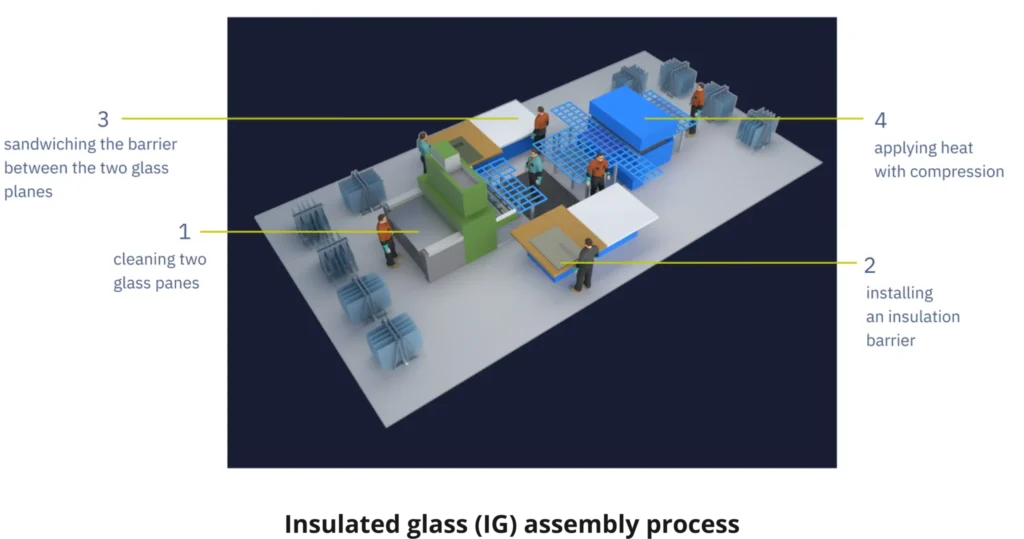
The insulated glass (IG) assembly process consists of four (4) primary operational steps. These steps include:
Cleaning two glass panes
Installing an insulation barrier
Sandwiching the barrier between the two glass planes
Applying heat with compression
Since homes have a variety of window and door sizes, the manufacturing processes must be setup to simultaneously run mixed model sizes. The processes must be highly synchronized in order to flow together at the exact time to assemble the final product.
The challenge
Time Studies generate only sample data and hence missed vital information and variations
Time studies tend to bias against the cumulative effects of the ‘insignificant few’ root causes
An IG assembly area essentially supplies glass to all final product assembly lines and hence is typically the bottleneck in the overall product assembly process. As a consequence, upstream delays due to material shortages, resource deficiencies and unplanned downtime, causes capacity constraints on the entire assembly line. This in-turn affects customer satisfaction levels (due to delayed product shipment) and employee satisfaction levels (due to excessive demand for over-time hours).
The solution
Rheo provided process owners with prioritized improvement insights.
Rheo empowered process owners with the knowledge to manage and drive improvements.
RHEO AI Smart Operational Platform was deployed to automate data collection, analysis and process visualization. The system with its ability to continuously monitor was able to measure and account each and every inefficiency incidence, including those that typically get deemed to be insignificant. As a consequence of the inherent continuous and exhaustive nature of the RHEO platform to identify root causes, the platform was able to recognize the effect of lack of steady supply of glass upstream in the process, leading to a re-allocation of resources, thereby improving the Units Per Worker Hour (UPWH) dramatically.
The results
The pilot which lasted for a month, identified the following benefits:
Management – Improved productivity resulted in Six Figure EBITDA labor savings of across two lines.
Employees – Need for overtime was significantly reduced. Performance-based bonuses compensated for the overtime work loss resulting in increased Team morale (increased pay and improved work life balance).
Customer – On-time customer delivery was consistently achieved without undue effort and additional planning.
Laminated Glass Manufacturer
Rheo AI Smart Operational Platform helps major US Laminated Glass manufacturer increase production line capacity and reduce labor costs
Abstract
A US leader in Laminated Glass manufacturing needed to increase capacity to satisfy customer demand while simultaneously improving labor productivity
Challenges
The operation’s team lack visibility into the process bottlenecks and constraints
Production dashboards were not in place to provide process performance and improvement insights
Supervisors were looking to management to provide operational improvement direction instead of seizing ownership and driving continuous improvement initiatives
Overtime was being used to achieve customer service commitments
Results
Realized a 97% increase in daily units
Increased employee job satisfaction
Supervisors were looking to management to provide operational improvement direction instead of seizing ownership and driving continuous improvement initiatives
Supervisors have embraced the new empowerment and are using the RHEO system to identify, prioritize, implement and sustain process improvements
Aerospace Manufacturer
RHEO AI Smart Operational Platform helps major Aerospace manufacturer increase overall equipment effectiveness and reduce overtime labor cost
Abstract
A High Mix Low Volume (HMLV) sheet and plate polishing company servicing the Aerospace industry was experiencing process efficiency challenges resulting in longer customer lead times, higher labor costs and declining financial margins
To improve the process efficiency and financial performance, the business needed to quickly understand the primary factors impacting the operational performance while simultaneously deploying rapid improve initiatives
Challenges
The operational team was lacking an Operational Management System (OMS) to proactively and adaptively address inefficiencies to improve performance
Overtime was being used to achieve on-time customer service commitments
Results
Reduced overtime by greater than 85% in Forming, Grinding and Polishing in 6 weeks of deployment
Achieved $455k EBITDA savings in 6 months
Windows and Doors Manufacturing Conglomerate
RHEO AI Smart Operational Platform helps major industrial manufacturer reduce labor cost in glass cutting while simultaneously improving customer service levels
Abstract
A division of one of the top residential Windows and Doors manufacturing conglomerate was experiencing increasing labor costs, while daily throughput remained flat and on-time customer service levels were deteriorating
To improve service levels and reduce labor cost, the business needed to quickly understand the primary factors impacting performance of the glass cut process and the specific improvements required to rapidly improve performance
Challenges
Extremely complex process interactions between production scheduling, multiple manufacturing departments and shipping
High employee turnover and absenteeism
Increasing labor rates
Increasing unplanned equipment downtime
Translation of managements qualitative opinions to quantitative facts and data
Results
Identified EBITDA labor savings of over Six Figures in the first two weeks of introducing the RHEO system
Manufacturer is currently deploying the RHEO system across all of their plants
Aerospace Manufacturer
RHEO AI Smart Operational Platform helps major industrial manufacturers reduce labor cost while simultaneously improving customer service levels
Abstract
A sheet and plate grinding department was struggling with characterizing job efficiency and margin performance
The business needed to move quickly to identify specific actions necessary to improve operational performance and increase EBITDA
Challenges
Time standards were incomplete and inaccurate
Production dashboards were not in place to provide machine or operator in-process performance and improvement insights
Supervisors were not given process ownership and empowerment to drive continuous improvements
Results
Reduced material scrap by 3%
Increased labor productivity by 62%
Supervisors have embraced the new empowerment and are using the RHEO system to identify, prioritize, implement and sustain process improvements
Laminated Glass Manufacturer
RHEO AI Smart Operational Platform helps major US Laminated Glass manufacturer increase production line capacity and reduce labor costs
Abstract
A US leader in Laminated Glass manufacturing needed to increase capacity to satisfy customer demand while simultaneously improving labor productivity
Challenges
The operation’s team lack visibility into the process bottlenecks and constraints
Production dashboards were not in place to provide process performance and improvement insights
Supervisors were looking to management to provide operational improvement direction instead of seizing ownership and driving continuous improvement initiatives
Overtime was being used to achieve customer service commitments
Results
Realized a 97% increase in daily units
Increased employee job satisfaction
Supervisors were looking to management to provide operational improvement direction instead of seizing ownership and driving continuous improvement initiatives
Supervisors have embraced the new empowerment and are using the RHEO system to identify, prioritize, implement and sustain process improvements
Aerospace Manufacturer
RHEO AI Smart Operational Platform helps major Aerospace manufacturer increase overall equipment effectiveness and reduce overtime labor cost
Abstract
A sheet and plate polishing company servicing the Aerospace industry was experiencing machine efficiency challenges and lacked the operational systems to provide real-time process improvements insights
To improve machine efficiency and control cost, the business needed to quickly understand the primary factors impacting performance of each department and determine the specific improvements required to rapidly improve performance
Challenges
The operation’s team was lacking an Operational Management System (OMS) to proactively and adaptively address inefficiencies to improve performance
Overtime was being used to achieve on-time customer service commitments
Results
Reduced overtime by greater than 85% in Forming, Grinding and Polishing
Achieved $455k EBITDA savings in 6 months
Windows and Doors Manufacturing Conglomerate
RHEO AI Smart Operational Platform helps major Window and Door manufacturer to improve Customer Ontime Delivery and Operational Performance
Abstract
A high-volume Windows and Doors conglomerate’s largest business unit was experiencing surging demands, employee turnover and shortages, and increasing customer lead-times
The business operates on a 24-hour schedule with all shifts comparatively planned and staffed
To overcome the capacity and customer service level headwinds, the businesses needed to quickly scale process improvement initiatives across the business utilizing production staff
Challenges
Supervisors lack the vital process information to quickly identify and prioritize improvement opportunities
Daily units per day was 18% lower than established business objectives
Multiple production lines making similar products were functioning as silos with suboptimal standardization and cross learning
Results
Supervisors – Led the continuous improvement efforts to unlocked capacity in their responsible areas with minimal support from the continuous improvement team and management
Manufacturing – Realized a 35% increase in daily units on three production lines in a three (3) week period
Plant – Significantly reduced day-to-day throughput variation across shifts and lines
Aerospace Manufacturer
RHEO AI Smart Operational Platform helps major Aerospace manufacturer increase overall equipment effectiveness and reduce overtime labor cost
Abstract
A 40-year-old privately held company which provides precision grinding and polishing services to the aerospace industry was experiencing declining overall equipment effectiveness, increasing overtime cost and lacked the operational systems to provide real-time information on the business performance
The business needed to quickly understand the primary factors impacting the grinding and polishing processes and implement specific improvement actions to rapidly improve performance
Challenges
The operational team was lacking a real-time Operational Management System to proactively and adaptively address inefficiencies and drive daily incremental improvements
Operational information did not provide department, machine or operator in-process performance and real- time actionable improvement insights
Results
Reduced overtime cost by 95%
Windows and Doors Manufacturing Conglomerate
RHEO AI Smart Operational Platform helps major industrial manufacturers to improve Employee Satisfaction and Reduce Overtime Cost
Abstract
A leading manufacturer of windows and doors needed to grow capacities to support the surging building market demand
Challenges
Space limitations and long machine lead times are preventing the addition of new production lines to support the capacity increases
Supervisors were slow to embrace kaizen improvement events to identify bottlenecks in the process
Production line output was 150-200 units/ shift lower than their parent plant
Travel during Covid was limited which prevented the team from visiting the parent facility to identify the flow differences
Vital statistical information needed for decision making was difficult to obtain
Results
Supervisors – Led the continuous improvement efforts to unlocked capacity in their responsible areas with minimal support from the continuous improvement team and management
Manufacturing – Realized a 35% increase in daily units on three production lines in a three (3) week period
Plant – Significantly reduced day-to-day throughput variation across shifts and lines
Windows and Doors Manufacturing Conglomerate
RHEO AI Smart Operational Platform helps major industrial manufacturers to improve Employee Satisfaction and Reduce Overtime Cost
Abstract
A division of a one of the top residential Windows and Doors manufacturing conglomerate was experiencing excessive labor overtime in their insulated glass (IG) assembly process, resulting in low employee satisfaction, high employee turnover, and increasing labor cost
To rapidly turn-around this undesired situation, the business needed to quickly understand the root causes impacting the work center capacity and disproportionate overtime hours
Challenges
Process historical performance was based on sample data and hence missed vital information and variations
Process observations tended to bias against the cumulative effects of the ‘insignificant few’ root causes
Management relied primary on qualitative tribal knowledge and experience to decided on process improvement initiatives
Results
Management – Improved productivity resulted in Six Figure EBITDA labor savings across two production lines
Employees – Need for overtime was significantly reduced
Customer – On-time customer delivery was consistently achieved without undue effort and additional overtime cost